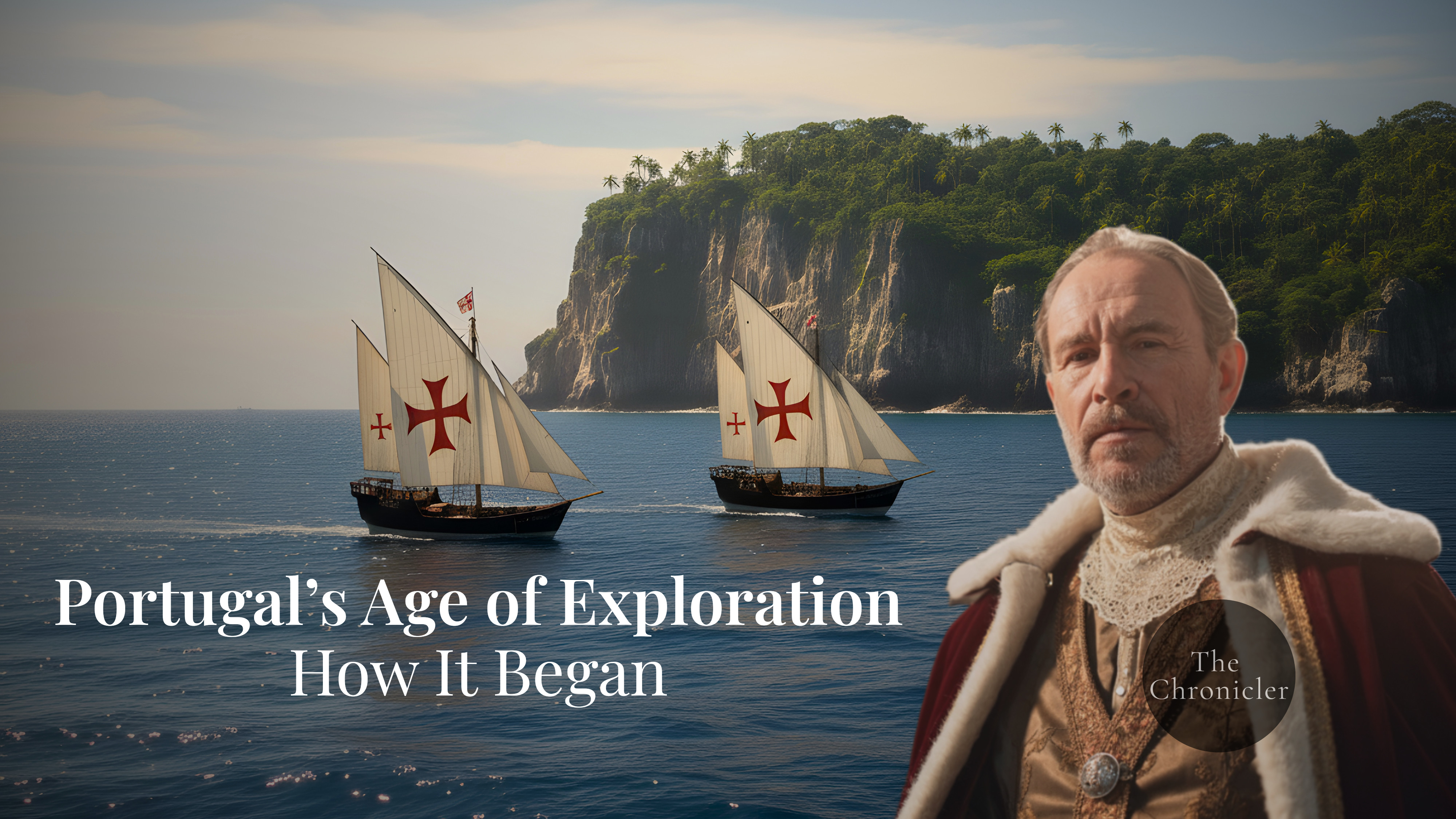
In 1497, King Manuel I made the greatest gamble in Portugal’s history. He entrusted an unknown captain — Vasco da Gama — with a mission so ambitious it bordered on impossible: reach India by sea, unite with lost Christian kingdoms, and seize the riches of the Orient.
If Da Gama succeeded, Portugal could become the richest nation on Earth. If he failed, the kingdom risked humiliation and ruin.
Historical Background
By 1497, Portugal had spent decades preparing for this moment. Bartolomeu Dias had proved the route around Africa was open. Pêro da Covilhã had mapped the Indian Ocean trade from the inside. All that remained was the voyage itself — the longest ocean journey any European had ever attempted.
The Fortunate King’s Gamble
King Manuel I, known as “O Afortunado” (The Fortunate), understood that reaching India by sea would transform Portugal overnight. The spice trade — pepper, cinnamon, cloves, and nutmeg — was the most lucrative commerce in the known world, controlled by Venetian and Arab intermediaries. A direct sea route would bypass them entirely.
Vasco da Gama — The Captain
Da Gama was not Portugal’s most experienced navigator. He was chosen for his diplomatic skills, his iron will, and his willingness to use force. On July 8, 1497, four ships departed the Restelo shipyards in Lisbon — the São Gabriel, São Rafael, Berrio, and a supply vessel — carrying approximately 170 men on a voyage into the unknown.
The Atlantic Gambit
Rather than hugging the African coast, Da Gama made a bold navigational decision: he swung far west into the open Atlantic, sailing for 96 days without sight of land — the longest ocean passage in recorded history at that time. This wide arc caught the South Atlantic trade winds and carried the fleet around the Cape of Good Hope with fewer storms than Dias had faced.
The Swahili Coast
Arriving on the East African coast, Da Gama encountered the sophisticated trading cities of Mozambique, Mombasa, and Malindi. These Swahili ports were part of a vast Indian Ocean trading network connecting Africa, Arabia, Persia, and India. At Malindi, Da Gama secured the services of an experienced navigator — Ahmad ibn Majid — who guided the fleet across the Indian Ocean using monsoon winds.
Legacy
Da Gama’s departure from Lisbon in 1497 set in motion a chain of events that would reshape global trade, connect continents, and establish Portugal as the first European power with a direct maritime link to Asia. The world’s balance of power shifted forever.